FINAL POST
WEEK 12
This week, we read Judith Butlers, “Performative Acts and Gender
Constitution: An Essay in Phenomenology and Feminist Theory” the paper discussed how gender and sex are separate things and how gender is more
of an ever changing social idea, than something set in stone. Think of
what was considered a woman 60 years ago compared to today. Women of the
past were expected to stay at home and be the baby makers. The women of
today can be that, if that's their choice, as our current society in
our country sees women as more independent people. However, the other
end of the spectrum is never considered. What is a man? How have men
changed though out history? And why does the change in gender strangely
scare some people? The man in the picture below is an excellent example
as he was assigned a woman at birth, yet became a gangster in the 50's.
His name is Dante Tex Gill.
Gill,
similar to many trans men, is a difficult subject to research. Their
histories are often barely recorded, belittled, or simply ignored all
together. The closest thing I could find to a "proper source" on him was
the article Dante “Tex” Gill – World Queerstory by Queerstory. Many of the other sources misgender or flat out dead name him, despite strong evidence from people who were close to him describing him as male.
Regardless, Dante serves as an excellent example of what men were and
could be. Between being a typical gangster, he also had many "un
masculine" hobbies. Many of the women he was with said they were treated
respectfully and he loved working with horses. His attitude was so
memorable that years later, people tried to create his bibliography into
film, infamously casting Scarlett Johansen to the ire of many members of the community as she was a cis woman playing a trans man, carrying the message that trans men are confused women. To me, many men of today are afraid that if the stereotypical,
"strong man" archetype changes, that they won't know what makes them
"them". Afraid that people are secretly organizing to take their
masculinity away. Which, as we've seen with Gill, gender is merely what
you make it. Men of ancient Rome are not the same men that live in
America today and holding onto ancient stereotypes helps no one. Men
need a positive movement forward that encourages them to be themselves
and not be afraid of who they see.
Judith Butler, “Performative Acts and Gender Constitution: An Essay in Phenomenology and Feminist Theory,” Theatre Journal, 1988
WEEK 10
This week, we read "Meaning, Identity, Embodiment" by Amelia Jones. The book covers gender identity and art through Gustave Courbet's painting "The Origin of the World". The origin of the world painting is a vagina with pubic hair and the rest of the figure is covered by a white blanket.

Gustave Courbet (1819-1877) The Origin of the World 1866 Oil on canvas
Why paint a vagina? And why cover the rest of the persons body? Amelia Jones book theorizes that Courbet painted this to showcase humans focus on what they see in the flesh as opposed to what makes the person who they really are, outside of their sex. To me, the focus is completely upon their genitals as that is what people from the late 18th century would have seen in women. The painting confronts the audience with this image to make them face what they really see. The only visible element of this piece is the persons body as the cloth covers the rest. Typically with a piece featuring a nude woman, the male gaze is focused on the shape of the womans body or her breasts. The area that most men are obsessed with, yet never want to see outside of when they are the ones "using it" is the vagina. The pieces shows mans true ugly desires. There is also the title of the piece "The Origin of the World". The place where every human comes from and yet the only element people can focus on is usually the shape of the persons body or their breast size. The art reminds me of the classical roman sculptures and how asking the modern person what they remember about those statues isn't the artistry or the pose, it's the nudity. While there are still very many negative gender norms within our society, it's interesting how something such as this painting would still be remembered for the exact reason Courbet would expect. Though the painting would probably still be in controversy as it's a woman genitals, something rarely every drawn or seen by the average art viewer.
Jones, A. (2003). Meaning, Identity, Embodiment: The Uses of
Merleau‐Ponty's Phenomenology in Art History. In Art and Thought (eds D.
Arnold and M. Iversen). https://doi.org/10.1002/9780470774199.ch4
WEEK 7
Cinema has changed significantly from 1992, when the book In Black Looks:Race and Representation by
Bell Hooks, was written. In chapter 7 of the book, Bell hooks describes
how people of color have been seen through media. A great recent
example of a movie where a black female character is empowered and is an
example of a non stereotypical black character, is the 2019 horror
movie, Us.
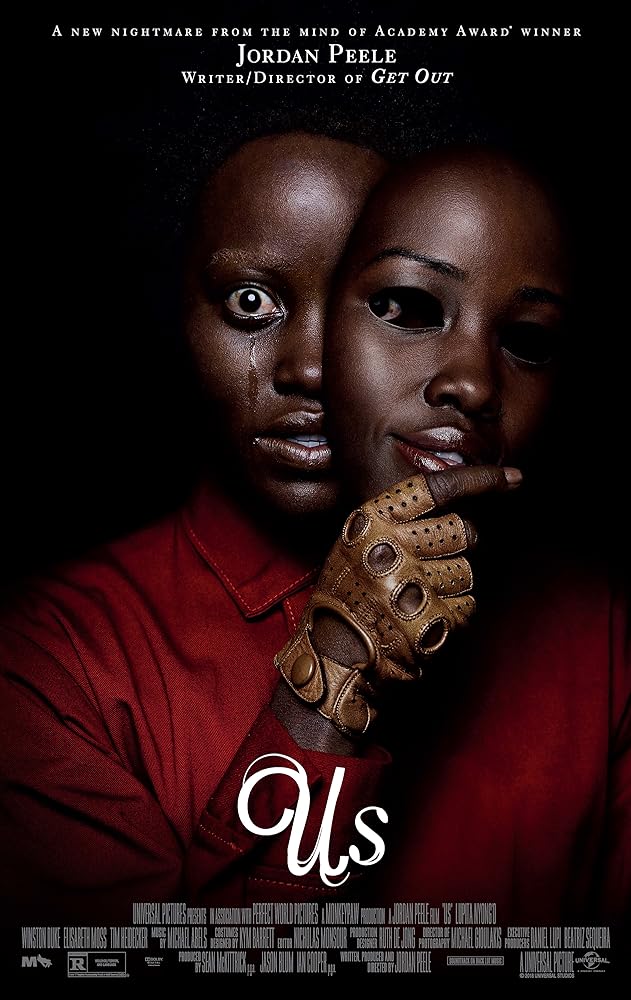 In
the film, Adelaide defends her family from doppelgangers that have
appeared and begun killing people. In any other film, she would be cast as a sassy sidekick character, though the film creates a real family instead of a cartoon one. The idea of the gaze plays a major
role in the film as the doppelgangers often stare at the family or vice
versa. To pull a quote from In Black Looks, "The politics of
slavery, of radicalized power relations, were such that the slaves were
denied their right to gaze"(Hooks 1992). In the film, the right to gaze is literally
denied to the doppelgangers as they dwell under the earth. When one of
them finds the surface, it is through a fun house mirror revealing their
"other" on the opposite side of the mirror. The whole deeper meaning in
the film is more connected with Hands Across America, rather than
African American issues, though the Hands Across America idea does
connect with how people of lower classes can become more connected and
rise, even though there are holes in their connections. The stereotype
with many black characters, especially initial ones in film and media,
is they are created to serve white people. Typically a maid or a
secondary character, comedy relief role. However, with the increase in
black film makers in Hollywood, their representation has gotten better,
though it is still lacking compared to their white counterparts. Many
television shows and movies where the black character isn't placed as a
comedy relief or as an assistant character, they're surrounded by white
characters. Even when the black character is the main character, there
is an odd trend among certain mediums, specifically animation, where the
black character transforms or is hidden in some way throughout the
movie. It's hard to see representation as a child, when you literally
can't see representation. However, representation is a slow and grueling process. From 1992 to today, things have changed though still glacially slow. We have characters like Adelaide from Us, Garnet from Steven Universe, and Craig from Craig from the Creek, who are positive representations. Yet only one is from a successful movie where they are the main character. Garnet is a side character and Craig from the Creek wasn't as successful as its competition.
In
the film, Adelaide defends her family from doppelgangers that have
appeared and begun killing people. In any other film, she would be cast as a sassy sidekick character, though the film creates a real family instead of a cartoon one. The idea of the gaze plays a major
role in the film as the doppelgangers often stare at the family or vice
versa. To pull a quote from In Black Looks, "The politics of
slavery, of radicalized power relations, were such that the slaves were
denied their right to gaze"(Hooks 1992). In the film, the right to gaze is literally
denied to the doppelgangers as they dwell under the earth. When one of
them finds the surface, it is through a fun house mirror revealing their
"other" on the opposite side of the mirror. The whole deeper meaning in
the film is more connected with Hands Across America, rather than
African American issues, though the Hands Across America idea does
connect with how people of lower classes can become more connected and
rise, even though there are holes in their connections. The stereotype
with many black characters, especially initial ones in film and media,
is they are created to serve white people. Typically a maid or a
secondary character, comedy relief role. However, with the increase in
black film makers in Hollywood, their representation has gotten better,
though it is still lacking compared to their white counterparts. Many
television shows and movies where the black character isn't placed as a
comedy relief or as an assistant character, they're surrounded by white
characters. Even when the black character is the main character, there
is an odd trend among certain mediums, specifically animation, where the
black character transforms or is hidden in some way throughout the
movie. It's hard to see representation as a child, when you literally
can't see representation. However, representation is a slow and grueling process. From 1992 to today, things have changed though still glacially slow. We have characters like Adelaide from Us, Garnet from Steven Universe, and Craig from Craig from the Creek, who are positive representations. Yet only one is from a successful movie where they are the main character. Garnet is a side character and Craig from the Creek wasn't as successful as its competition.
Hooks, Bell. (1992). Black looks : race and representation. South End Press.


Comments
Post a Comment